 Subscribe by RSS
 From Dr. Timothy Bratton…
Jan. 31, 2018 (Wed.): The month concludes with a bang as a total lunar eclipse takes place this morning. Below is the chronology of this event for Jamestown:
4:50 a.m.: The eastern rim of the Moon, which will be then 99.98% sunlit and 30.6 degrees above the WSW-W skyline, makes contact with the penumbra (the Earth’s fainter outer shadow). The penumbra is so faint that it will not become noticeable for a half-hour or so, when the eastern part of the Moon might display a darker grayish tint. Wearing sunglasses (of all things!) often heightens the contrast between the penumbra and the rest of the Moon. Meteorologist and astronomer Joe Rao also recommends projecting the lunar image through a telescope eyepiece on to a sheet of paper; this too increases the contrast, and has enabled him to detect the penumbra within 33 minutes after the start of lunar eclipses.
5:48 a.m.: The partial stage of the eclipse begins when the Moon’s eastern rim makes contact with the Earth’s umbra, or darker inner shadow. At this time Luna will be almost 21 degrees over the western horizon and 99.99% lit.
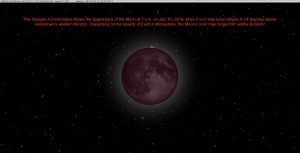
6:51 a.m.: Total eclipse begins as the Moon, now 16 1/3 degrees above the W-WNW skyline, moves fully into the Earth’s umbra. Because some sunlight is refracted through the Earth’s atmosphere and reaches the lunar surface, the Moon is not darkened completely; it probably will be colored orange. The “wild card” this year might be the smoke from the California forest fires; if enough soot is thrown into the atmosphere, the light reaching the Moon will be reduced, so that it appears reddish, brick-red, or grey. I saw a total lunar eclipse near Cleveland, Ohio, in 1963 where the Indonesian volcano Mt. Pinatubo had thrown so much ash into the sky that the Moon disappeared entirely at mid-eclipse; except for a circular gap in the star field, nobody would have realized that the Moon was there! What will pan out during this month’s eclipse?
7:27 a.m.: Full Moon occurs technically with the Moon directly opposite the Sun (which from a lunar perspective would be a total eclipse of the Sun, with the darkened Earth surrounded by a halo of fiery light). At this moment the Moon will be just less than 5 degrees over the WNW horizon, 33.228 arc-minutes across, and 223,816 miles away.
8:04 a.m.: The Moon sets on Jamestown’s WNW horizon, mere minutes before its eastern limb exits from the Earth’s umbra.
8:08 a.m.: The Moon begins moving out of the umbra, returning to a partial eclipse stage.
9:12 a.m.: The Moon departs entirely from the Earth’s umbra, returning to the penumbral eclipse stage.
10:10 a.m.: The eclipse ends entirely as the Moon exits the Earth’s penumbra.
On July 27 there will be another lunar eclipse, but it will be visible primarily from central Africa and central Asia.
Celebrate the New Year with this spectacular heavenly event (and pray that the weather will cooperate!).













Comments are closed
Sorry, but you cannot leave a comment for this post.